
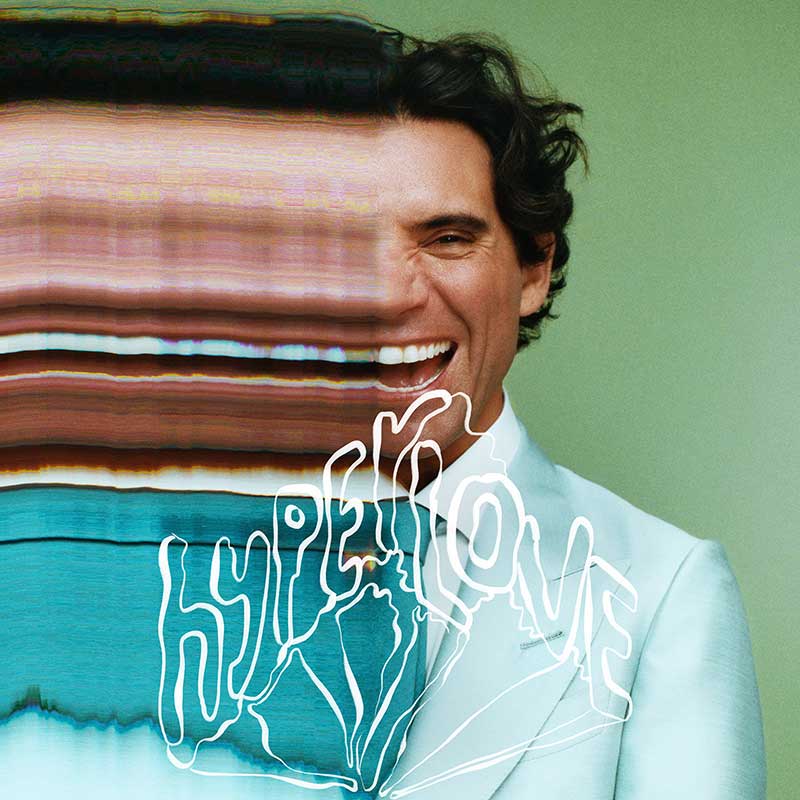
For nearly two decades, MIKA has stood apart as a singular force in modern pop music — a songwriter, vocalist, and performer whose work unites exuberant craftsmanship with disarming emotional depth. With Hyperlove, his first English-language album since 2019’s My Name Is Michael Holbrook, he enters a bold and richly personal new chapter. The record marks both a reinvention and a return: a joyous return to the piano as his creative compass, and a forward-looking exploration of how human emotion can coexist with the accelerating velocity of the digital world.
The emotional heart of Hyperlove emerged from two unwavering sources of devotion: the loss of his mother, Joannie Penniman, in 2020, and the presence of his beloved golden retriever, a constant companion throughout his creative life. Their influence is felt across the record, from the tenderness in his vocals to the album’s meditations on memory, legacy, and love that refuses to disappear.
“My mother formed me,” MIKA says. “But I realized I wasn’t just her creation. I was able to confront everything she shaped in me – my desires, my imagination, my fears — and still find peace.”
The exquisite final track, “Immortal Love,” became an unexpected tribute to the golden retriever whose presence accompanied every album he has written. “I realized I hadn’t made a single record without her. In her energy, I felt something immortal,” he recalls. “I had to honor that.” The song is a meditation on loyalty, constancy, and the unseen bonds that define life.
Hyperlove, itself, is a collision of worlds. It matches the pristine sheen of electronic pop with analogue imperfection and warmth. At its core is a deceptively simple question: How do we live with technology without losing our souls? The answer unfolds through songs that radiate longing, curiosity, and precision.
The genesis of the album began not in a pop studio, but a symphonic hall. MIKA was completing a large-scale orchestral project – a soundtrack performed by 260 musicians, including soloists from the Paris Opera and Berber instrumentalists. The process reawakened the spark he first felt studying music as a boy. “Working with the orchestra made me feel less lonely,” he says. “As though the synapses were reconnecting.”
The experience inspired a radical commitment: Every song on Hyperlove would begin at the piano.
“I went back to my piano: this hyper-complicated, gloriously mechanical machine that lets me make any kind of music. The entire album had to be written there. I decided I would co-write it with the piano… and trust the chaos.”
From those keys came overlapping patterns, disarming simplicity, and emotional architectures shaped by mythology, desire, fantasy, and the tension between private inner worlds and the sometimes alienating surfaces of the digital present. A conceptual framework formed: hyperspace versus space, digital present versus analogue past, the wildness of imagination versus the machinery of society.
“We have our inner mythology — fantasy, desire, want,” he says. “But that fantasy lives against a massive machine: technology, community, reality itself. Hyper-love is the electricity between them.”
The album revels in sweetness, brightness, sensitivity, and the ecstatic charge of contradiction. At its core is pop music unafraid of fragility, sensuality, or the darker corners of longing. Reuniting with Nick Littlemore — producer of The Origin of Love and creative mind behind PNAU and Empire of the Sun — MIKA set one uncompromising rule:
“Every sound must come from analogue or vintage outboard gear. Nothing quantized. Nothing perfectly in tune.”
This disarming imperfection gives the album its pulse. His classically trained voice becomes both lead and landscape: layered in harmonies, bent electronically, used rhythmically, or stacked into choirs of selves. The result is tactile and alive.
“Modern Times” flirts with glossy pop while nodding to the nervy emotional currents that run through Talking Heads. The exhilaration and unease of longing is made melodic. “Excuses for Love” beautifully explores the obstacles we build around the heart, while also imagining a world where the barriers to affection could be dissolved with honesty and courage. And several times throughout the album, the legendary John Waters appears as guest narrator, speaking in clever interludes that wink, provoke, and frame the set’s landscape with his singular wit.
Though the record looks forward, MIKA’s career remains a story of boundary-shattering imagination. Born Michael Holbrook Penniman Jr., he exploded onto the global stage with his debut single “Grace Kelly” in 2007, which sold over 3 million copies and became the second UK No. 1 achieved through downloads alone. His debut album, Life in Cartoon Motion, earned 2.8 billion streams, 8.3 million albums sold, and 12.8 million digital tracks, topping charts in twelve countries.
The momentum continued with The Boy Who Knew Too Much (2009), home to “We Are Golden,” “Blame It on the Girls,” and “Rain.” In 2011, his French-language hit “Elle Me Dit” spent eight weeks at the top of the country’s charts and became the year’s second best-selling single. By the time The Origin of Love arrived in 2012—with contributions from Pharrell Williams and Ariana Grande—MIKA had established himself as a global innovator. His 2015 release No Place in Heaven, crafted with Gregg Wells, drew acclaim for its clarity, craftsmanship, and emotional candor.
Across television, he has brought his magnetism to millions: as a judge on X Factor Italy, a coach on The Voice France, and as the host of the award-winning Italian program Stasera Casa Mika, which earned the 2017 Rose d’Or. In the UK, he will soon film the fourth season of The Piano, mentoring amateur musicians who perform spontaneously on train station concourse pianos.
My Name Is Michael Holbrook (2019) marked a turning point: a deeply personal album tracked live with vintage synths and suffused with resilience. After the 2020 Beirut explosion, MIKA organized I Love Beirut, a global benefit filmed from his home, featuring Kylie Minogue, Rufus Wainwright, and others—raising over €1 million for relief efforts and reaching viewers in 106 countries.
Hyperlove now represents a new intersection of craft and humanity. It is romantic yet questioning, sleek yet intentionally rough. It is born from conflict, curiosity, grief, surprising joy, and ultimate rediscovery.
At its core, it is about possibility: the same possibility MIKA felt as a boy in Paris, sitting before a white chipboard piano salvaged from a shuttered rental company just as he was expelled from school. “I started sitting at that piano every day,” he says, “and that’s when it happened. When I began to feel music deeply. When I understood that melody could create connection of every kind.”
That belief continues to draw millions to his work: listeners who crave not just pop, but pop with soul.
“Fundamentally, everything I do is for that kid who gets excited by what a song can do,” he says. “Because I was that kid. I still am that kid. We’re all those kids. It’s all about possibility.”